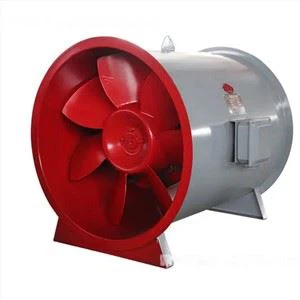
As a trusted centrifugal fan supplier, I've witnessed firsthand the diverse applications and critical roles these fans play across various industries. Centrifugal fans are essential for air movement, ventilation, and exhaust systems, and their performance is significantly influenced by the inlet and outlet configurations. In this blog post, I'll delve into the common inlet and outlet configurations of centrifugal fans, shedding light on their features, advantages, and typical applications.
Common Inlet Configurations
Single Inlet (SI)
The single inlet configuration is one of the most straightforward and widely used designs. In a single inlet centrifugal fan, air enters the fan through a single opening on one side of the impeller. This design is simple, cost - effective, and suitable for many general ventilation and air - handling applications.
The impeller in a single inlet fan rotates, creating a low - pressure area at the inlet. Air is then drawn into the fan, accelerated by the impeller blades, and discharged at a higher pressure through the outlet. Single inlet fans are commonly used in HVAC systems, small industrial ventilation setups, and residential air - circulation applications.
One of the main advantages of single inlet fans is their compact size. They are relatively easy to install and can be integrated into existing systems with minimal modifications. However, their air - handling capacity is limited compared to some other configurations, as they only draw air from one side.


Double Inlet (DI)
Double inlet centrifugal fans, as the name suggests, have two inlets, one on each side of the impeller. This design allows the fan to draw air from both sides simultaneously, significantly increasing the air - handling capacity compared to single inlet fans.
The impeller in a double inlet fan is designed to handle the increased airflow. The two streams of air are combined within the fan and then discharged through the outlet. Double inlet fans are commonly used in large - scale HVAC systems, industrial processes that require high - volume air movement, and in applications where space is limited but high airflow is essential.
The main advantage of double inlet fans is their high airflow capacity. They can move large volumes of air with relatively low power consumption, making them energy - efficient for high - demand applications. However, they are more complex and expensive to manufacture and install compared to single inlet fans.
Common Outlet Configurations
Radial Outlet
A radial outlet centrifugal fan discharges air in a direction perpendicular to the axis of the impeller. The air is accelerated by the impeller blades and then exits the fan in a radial direction. Radial outlet fans are commonly used in applications where the air needs to be directed horizontally or vertically, such as in ductwork systems.
The radial outlet design provides a high - pressure output, making it suitable for applications that require overcoming significant resistance, such as long duct runs or systems with multiple bends. Radial outlet fans are often used in industrial ventilation, dust collection systems, and boiler exhaust applications. For example, our Industrial Boiler Exhaust Fan is designed with a radial outlet to efficiently remove exhaust gases from industrial boilers.
Tangential Outlet
In a tangential outlet centrifugal fan, the air is discharged tangentially to the impeller. This design allows for a more streamlined airflow, which can be beneficial in applications where low - noise operation is required. Tangential outlet fans are commonly used in HVAC systems, air curtain devices, and some types of industrial equipment.
The tangential outlet configuration provides a relatively low - pressure output but a high - volume airflow. The air is discharged in a narrow, focused stream, which can be useful for applications such as directing air over a specific area or through a narrow duct. Our Dust Exhaust Boiler Centrifugal Blower Industrial Fan can be configured with a tangential outlet for applications where a more focused airflow is needed for dust removal.
Axial - Radial Outlet
Axial - radial outlet centrifugal fans combine the features of axial and radial flow. The air initially enters the fan in an axial direction and then changes its direction to a radial direction as it is discharged. This hybrid design offers a balance between high - pressure output and high - volume airflow.
Axial - radial outlet fans are commonly used in applications where both high - pressure and high - volume air movement are required, such as in some large - scale industrial ventilation systems and power plant cooling towers. Our Ducted Centrifugal Fan For Conveying Air And Dust Removal Fan can be designed with an axial - radial outlet to meet the specific requirements of conveying air and removing dust in industrial ductwork systems.
Factors Influencing Configuration Selection
Airflow Requirements
The required airflow volume is a crucial factor in determining the inlet and outlet configurations. For applications that require high - volume air movement, double inlet fans are often the preferred choice. On the other hand, if the airflow requirements are relatively low, a single inlet fan may be sufficient.
Pressure Requirements
The pressure that the fan needs to generate is another important consideration. Applications with high - resistance ductwork or systems that require air to be forced through filters or other obstacles need fans with high - pressure output, such as those with radial outlets.
Space Constraints
The available space for installing the fan can also influence the configuration selection. Double inlet fans are generally larger than single inlet fans, so if space is limited, a single inlet fan may be a better option. Similarly, the layout of the ductwork and the available space for air discharge can determine the most suitable outlet configuration.
Noise Considerations
In applications where noise is a concern, such as in residential or office environments, fans with tangential outlets or those designed for low - noise operation are preferred. These configurations can provide a more quiet and comfortable working or living environment.
Conclusion
In summary, the inlet and outlet configurations of centrifugal fans play a crucial role in determining their performance, efficiency, and suitability for different applications. As a centrifugal fan supplier, we understand the importance of selecting the right configuration to meet the specific needs of our customers. Whether it's a single inlet fan for a small - scale ventilation system or a double inlet fan for a large - scale industrial application, we have the expertise and product range to provide the optimal solution.
If you're in the market for a centrifugal fan and need assistance in selecting the right inlet and outlet configuration for your project, please don't hesitate to contact us. Our team of experts is ready to help you make an informed decision and ensure that you get the best - performing fan for your needs.
References
- ASHRAE Handbook - HVAC Systems and Equipment. American Society of Heating, Refrigerating and Air - Conditioning Engineers.
- Fan Engineering, 7th Edition. Buffalo Forge Company.
- Industrial Ventilation: A Manual of Recommended Practice. American Conference of Governmental Industrial Hygienists.