


Centrifugal Fan
Centrifugal Fan Blade Types
Centrifugal fans come in four basic fan types, each with its own specific purpose.
Radial:
These fans provide medium airflow and high pressure. The finest fans for industrial settings with gas or moisture in the air, or when there is dust, are radial-bladed fans.
01
Forward Curve:
These fans are high airflow, medium pressure fans that can be utilized for exhaust, ventilation, and clean air applications.
02
Backward Curve:
These fans have a high flow rate, high pressure, and high efficiency. Over the most efficient portion of the system, power decreases as flow increases.
03
Airfoil:
When it comes to clean air applications, these fans have the maximum efficiency.
04


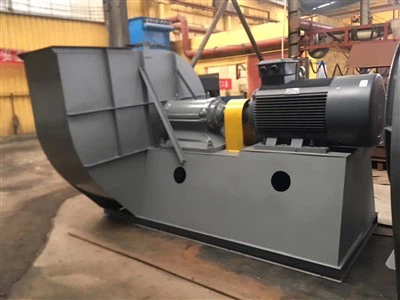


What is the structure of a centrifugal fan?
Centrifugal fans typically consist of a drive motor, the impeller and an inlet nozzle. In some use cases, the fan is surrounded by housing. Depending on the motor version, its speed can be controlled by connecting a frequency inverter or by means of integrated electronics (EC motors).

Depending on their design, the impellers of centrifugal fans differ in terms of their blade shape and their forward or backward-curvature. Forward-curved impellers require a helical spiral housing, which directs the discharged air in a particular direction. Due to their high output density, forward-curved impellers can achieve the same air handling capacity at a smaller size or lower speed compared to backward-curved impellers. Due to their mechanical design, forward-curved impellers are more likely to operate at lower speeds and are therefore used at smaller volume flows and lower pressure levels. In the case forward-curved centrifugal fans, there is a direct relationship between power consumption and flow rate, which means the operating point can be controlled by means of motor current and speed measurement.
In the case of backward-curved impellers, the efficiency of centrifugal fans can be significantly influenced by the design of the blades, eg their fluting. They are often welded, which allows higher mechanical loads due to higher speeds and thus higher pressures compared to forward-curved impellers. Backward-curved centrifugal fans can be operated as free-running fans with or without housing. Free-running fans often feature a modular design as a plug fan or ventilation unit to make installation easier for the user (plug & play). In the case of backward-curved centrifugal fans, air flow is often measured via a differential pressure measurement at the nozzle. Since there is no direct relationship between power consumption and flow rate, control via motor current is not possible.
What Are Centrifugal Fans Used For?
Heating, Ventilation, and Air Conditioning (HVAC) Systems
Centrifugal fans are widely used in HVAC systems for air circulation, ventilation, and temperature control in buildings, offices, shopping malls, hospitals, and other commercial spaces.
Industrial Ventilation
In industrial settings, centrifugal fans are employed for exhaust ventilation to remove fumes, dust, and other airborne contaminants, ensuring a safe and healthy working environment.
Dust Collection Systems
Centrifugal fans are a critical component in dust collection systems. They help draw in dust-laden air and transport it through filters to remove the particulate matter before releasing clean air into the atmosphere.
Air Pollution Control
Centrifugal fans are used in various air pollution control systems, such as scrubbers and electrostatic precipitators, to capture and remove pollutants from industrial emissions.
Industrial Ovens and Dryers
Centrifugal fans are used for circulating hot air in industrial ovens and dryers, ensuring even heating and drying of materials or products.
Cooling Systems
Centrifugal fans are utilized in cooling applications, such as cooling towers, radiators, and air-cooled heat exchangers, to dissipate excess heat from industrial processes and equipment.
Boilers and Furnaces
These fans aid in supplying combustion air to boilers and furnaces, ensuring efficient and controlled burning of fuels.
Agricultural Applications
Centrifugal fans are used in agricultural settings for grain drying, ventilation in livestock buildings, and other agricultural processing operations.
Air Handling Units (AHUs)
Centrifugal fans are a critical component in AHUs, which condition and circulate air in centralized HVAC systems.
Benefits Of Centrifugal Fans


High Pressure Generation
Centrifugal fans are excellent at generating high pressures, making them ideal for applications that require pushing or pulling air through ductwork, filters, or other systems with resistance to airflow.
Efficient Airflow Direction
Centrifugal fans direct airflow at a right angle to the fan's shaft, allowing for easy integration into ductwork or ventilation systems where airflow needs to change direction.
Versatility
These fans come in various designs and sizes, catering to airflow and pressure requirements. They can handle both low and high volumes of air and can be customized to suit specific applications.
Better Efficiency at Static Pressure
Unlike axial fans, centrifugal fans maintain their efficiency even when faced with higher static pressures. This characteristic is especially beneficial in situations with airflow resistance, such as in HVAC systems with long ducts or filters.
Noise Reduction
Centrifugal fans tend to be quieter than axial fans, primarily due to their design and airflow direction. The enclosed impeller and housing contribute to reducing noise levels, making them suitable for applications where noise is a concern.
Space Saving
Centrifugal fans can move a large air volume using a compact design, which can be advantageous in applications with limited space.
Wide Range of Applications
These fans find applications in various industries, including HVAC systems, industrial ventilation, dust collection systems, air pollution control, material handling, and more.
Balancing and Stability
The design of centrifugal fans ensures better balancing, reducing vibration and enhancing stability during operation.
Energy Efficiency
When properly selected and utilized in the appropriate applications, centrifugal fans can be energy-efficient, helping to save on operating costs.
Easy Control
Centrifugal fans can be equipped with variable frequency drives (VFDs) to allow precise airflow control and match the application's demand, further enhancing energy efficiency.
What are the maintenance methods of centrifugal fans?
The centrifugal fan needs to keep the air duct unblocked during operation. The power of the centrifugal fan will be overloaded when the air volume is small. Be careful not to use it for a long time in a sealed environment with an insufficient air supply. The current should be regularly monitored.
Before using the centrifugal fan, it is necessary to carry out the necessary test run on the fan. This process is to ensure the operation of the fan without failure, and the effectiveness of the fan is guaranteed to the greatest extent.
If the fan has not been used for a long time and now is used again, it is necessary to check whether the various parts of the fan are still firm. Once any looseness is found, it must be fastened in time. In this way, during the trial operation of the fan, it will not be unable to use normally due to the loosening of the fan components.
Before starting the fan, check whether there are any parts in the centrifugal fan and the pipeline that hinder the rotation. If there is any, it should be removed before starting.
After the fan is commissioned and no problems are found, it is put into use. It is necessary to observe the condition of the centrifugal fan regularly. Once an abnormality is found, it must be stopped for inspection immediately.
FAQ
Q: What is a centrifugal fan?
Q: What is the difference between a centrifugal fan and a normal fan?
Q: What is the difference between a blower and a centrifugal fan?
Q: Why use a centrifugal fan?
Q: When to use a centrifugal fan?
Given the reliability and durability of their design, centrifugal fans can operate well in many applications that function in harsh and dirty environments with particulates, hot air, and gasses.
Q: Are centrifugal fans more efficient?
Q: What are the characteristics of centrifugal fan?
Q: What is the efficiency of a centrifugal fan?
Q: Is a centrifugal fan used to pump air?
Q: What are centrifugal fans made of?
Impellers comprise a back plate, shroud (front) plate and blades. Forward-curved centrifugal fan impellers are manufactured from mild steel that is protected with a layer of zinc to help prevent corrosion.
Q: What is the direction of air flow in a centrifugal fan?
Q: What is the maximum pressure of centrifugal fan?
Q: How do you calculate the flow rate of a centrifugal fan?
Q: How can we increase centrifugal fan efficiency?
Q: How to design a centrifugal blower?
Q: Why use centrifugal fans?
Q: How to select motor for centrifugal fan?
Q: How does a centrifugal blower work?
Q: What is the direction of air flow in a centrifugal fan?
Q: What is the angle of a centrifugal fan?