Hey there, fellow mining crew members and industry folks! Let's cut to the chase-mining efficiency is make-or-break, right? Every extra ton moved, every minute saved, every safety box ticked? That's the stuff that keeps operations running smooth and bottom lines happy. But lately, I've been fielding a ton of questions from miners, site managers, even some junior engineers: Can a mining fan actually make a big difference in how efficient their whole setup is?
As someone who's been in the mining fan game for years-supplying gear that's built to handle the messy, tough side of underground and surface mining-I'm here to break this down, no jargon, no fluff. Let's start with the basics that most people overlook: mining fans aren't just about blowing air. They're the unsung heroes of every mine, dictating how clean air gets to faces, how dangerous dust and gas get pulled away, and even how long equipment lasts. So yeah-they absolutely can improve mining efficiency, if you've got the right fan for the job, not just any off-the-shelf unit.
First up, let's talk about the biggest efficiency killers in mines: poor air quality. If your crew is working in a space thick with coal dust, silica, or toxic gas like methane, two things happen fast. One, they get tired way quicker-can't focus, slower work cycles, more mistakes. Two, you're looking at OSHA or MSHA fines, downtime for mandatory air quality checks, and even safety shutdowns that cost you thousands per hour. A quality mining fan solves that, plain and simple.
Take our Industrial Mine Fan for Gas & Dust Suppression, for example. (Yeah, that's our link-go check it out if you want the specs.) This isn't your run-of-the-mill box fan. It's built with water mist tech that hooks right into the fan's airflow, so when it's pushing air through the tunnel or face, it's also capturing dust particles mid-air and pulling them out. I've seen sites swap out their old, ineffective dust collectors for these and cut their dust levels by 70% in a week. What does that mean for efficiency? Crews don't have to take extra breaks to suit up for dust, equipment filters don't clog as often (so less time changing filters), and you avoid those surprise air quality shutdowns. That's real, measurable efficiency-no guesswork.
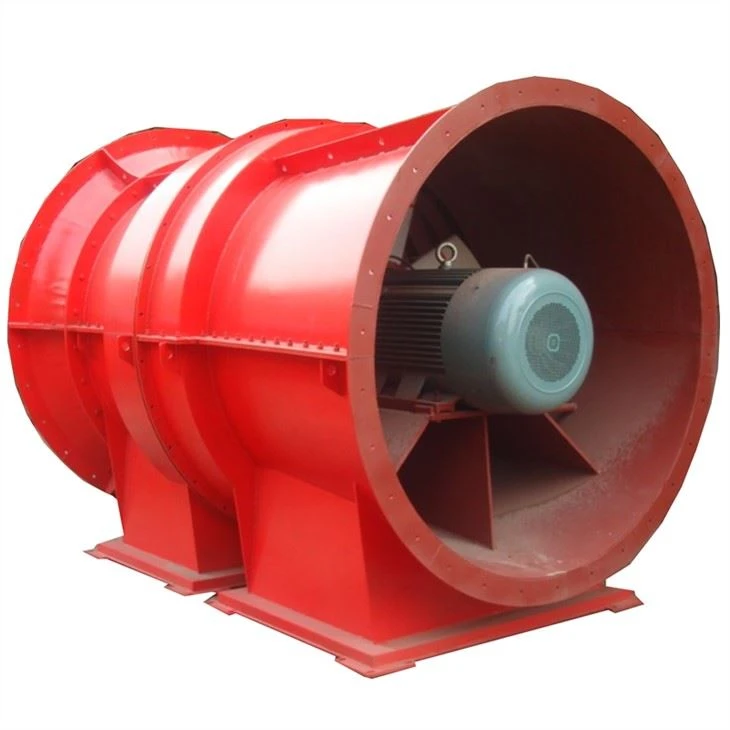
Then there's localized ventilation, which is super important for worksites that aren't in the main tunnel. If you've got a small excavation, a face that's just opened up, or a spot where temporary work is happening, you can't rely on the main tunnel's fan to push air all the way there. That's where Mine Local Fan comes in. These compact, high-powered units are designed to deliver targeted airflow exactly where it's needed-no wasted air, no dead zones. I had a customer last month at a coal mine that was working on a 500-foot lateral tunnel. They were using a regular axial fan that only pushed air 200 feet, so the crew was working in stale, dusty air, and they had to pause every two hours to move the fan closer. Swapping in our Mine Local Fan cut that downtime by 80%-they only had to adjust the fan once a shift instead of four times, and the face crew was way more productive with clean air. That's efficiency that adds up fast.
Wait, but what about when you need to pull air out, not push it? Like if you're dealing with heavy gas buildup or fumes from blasting? That's where extraction-type local ventilators come into play. Let's talk about Extraction-type Local Ventilator Under the Mine. These units are built to suck out bad air right at the source, before it spreads through the tunnel. For metal mines that have high radon levels or coal mines dealing with methane, this is non-negotiable. I worked with a metal mine in Pennsylvania a couple years back that was losing 12 hours a week due to radon levels exceeding limits because their old extraction fan was underpowered. After switching to our extraction local ventilator, they got their radon levels below the threshold in just three days, and that 12 hours a week? That's an extra 48 hours of production every month. That's not just efficiency-that's money in their pocket.
Now, let's get into surface mining, because a lot of people forget that surface operations have ventilation needs too. Tunnel Exhaust Fan-those are for those big open tunnels or surface mining tunnels where dust and fumes from loading equipment can hang around. If you've got a surface mine where haul trucks are idling or rock is being crushed, that exhaust fan pulls all that stuff away from the worksite, so the crew doesn't have to work in a cloud of diesel fumes or rock dust. I had a surface aggregate mine that was dealing with so much dust near their crushing plant that their loaders were taking 10 minutes longer per truck because operators could barely see. Swapping in our Tunnel Exhaust Fan cut that loading time by 2 minutes per truck, which added up to 15 extra trucks per shift. That's a 15% jump in production, all from a better exhaust fan.
But here's the thing-you can't just slap any mining fan on and expect efficiency gains. I've seen mines waste money buying cheap, generic fans that burn out in six months, or fans that are too big (wasting energy) or too small (not doing the job). The key is matching the fan to your specific needs. Let's break down what makes a fan actually boost efficiency, not just move air:
First, energy efficiency. A lot of operators overlook how much power a mining fan uses, especially if it's running 24/7. Our fans are built with high-efficiency motors that use less power while moving the same (or more) air. Over a year, that adds up to thousands in electricity costs. For example, a 50,000 CFM fan that's 15% more efficient saves about $8,000 a year in power-money you can put back into equipment, crew, or expansion.
Second, durability. Mines are brutal-dust, moisture, constant vibration. A fan that breaks down every week means downtime, which kills efficiency. Our mining fans are made with heavy-duty materials, sealed motors, and corrosion-resistant parts, so they last 5-10 years instead of 2-3. Less breakdowns = more production time.
Third, adjustability. Mining sites change all the time-you're digging deeper, opening new faces, moving worksites. Fans that can adjust their airflow, speed, or direction without taking them apart mean you don't have to stop operations to reconfigure ventilation. Our Mine Local Fans, for example, have variable speed controls, so you can crank up the airflow when you're blasting and turn it down when it's just crew working, saving more energy.
I know some people are thinking, "But our main ventilation system is already huge-how can a fan make that much difference?" Here's the secret: auxiliary fans (the local ones, extraction units, dust suppression fans) work with your main system to eliminate air dead zones. A main tunnel fan might push air down the tunnel, but if you don't have a local fan to pull that air into the worksite, or pull fumes out at the face, that main fan is wasting energy blowing air that never reaches where it's needed. It's like having a giant hose that's only blowing air into a corner-useless, until you add smaller hoses to direct the flow. That's exactly what our auxiliary mining fans do.
Let me share a real story to drive this home. A gold mine in Nevada hit a snag a couple years ago: their main tunnel fan was top-of-the-line, but their new deep excavation zone had no airflow. The crew was dealing with 2% methane levels (which is below the explosive limit, but close enough to be a risk) and silica dust levels that were forcing them to wear respirators full-time. They tried using a regular axial exhaust fan, but it couldn't pull air all the way to the excavation. They reached out to us, and we recommended our Mine Local Fan paired with our Extraction-type Local Ventilator Under the Mine. Within two weeks, their methane levels were at 0.1%, silica dust was down 80%, and the excavation crew's productivity went up 22% because they weren't restricted by bad air. The best part? The total cost of the two fans was recouped in three months from the extra production and avoided fines.
Now, I'm not saying a mining fan is a magic fix for every efficiency problem. You still need good maintenance, trained crew, and solid site planning. But a good, properly sized mining fan is one of the highest-ROI pieces of equipment you can buy for a mine. It's not just a ventilation tool-it's a tool that keeps crew safe, cuts downtime, reduces energy costs, and boosts production.
If you're reading this and thinking, "Our mine's ventilation is okay, but it feels like we're leaving efficiency on the table," or "We've had enough of dust and gas killing our production," let's talk. I've helped mines of all sizes-from small independent operations to large multinational ones-find the right mining fan setup for their specific needs. Whether you need a fan for gas and dust suppression, a local fan for a new excavation, an extraction ventilator, an axial exhaust fan, or a tunnel exhaust fan, we've got you covered. No one-size-fits-all, just solutions that work for your site.
Wait, one last thing-don't fall for the cheap fan trap. I see it all the time: operators buy a fan that's half the price of ours, but it burns out in a year, uses twice the power, and doesn't do the job. The upfront cost is lower, but the total cost of ownership is way higher, and the efficiency gains are nonexistent. Our fans are built to last, perform, and save you money in the long run. That's the kind of partner we are, not just a supplier.
So to circle back to the original question: Can a mining fan improve mining efficiency? Hell yes. But only if you pick the right fan for your job, pair it with good site planning, and invest in durable, efficient gear. We've seen it time and time again, and we're here to help you make it work for your mine. If you're ready to stop letting ventilation hold your operation back, reach out and let's chat. We can walk through your site, your needs, and find the perfect fan setup that will boost your efficiency, keep your crew safe, and put more money in your pocket.
References

- Mine Safety and Health Administration (MSHA). (2022). Ventilation Guidelines for Underground Metal and Nonmetal Mines. U.S. Department of Labor.
- International Society of Mining, Metallurgy, and Exploration (SME). (2021). Ventilation Efficiency in Surface and Underground Mining Operations. SME Annual Conference Proceedings.
- National Institute for Occupational Safety and Health (NIOSH). (2020). Respiratory Health Impacts of Mine Dust and Gas Exposure. NIOSH Publication.
- Energy Star. (2023). High-Efficiency Motors for Industrial Ventilation Systems. U.S. Environmental Protection Agency.