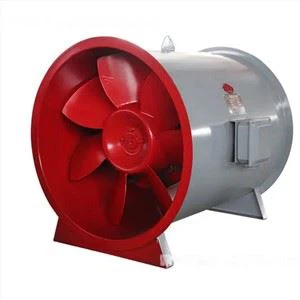
When I started working as an axial flow ventilator supplier three years ago, I quickly learned that a great axial flow fan doesn’t perform well in isolation. Last year, we had a client in the manufacturing industry who bought a high-powered axial flow unit from us but had to return it within a month. The issue? Their air duct system was poorly designed – mismatched sizing, rough internal surfaces, and improper turns meant the fan was wasting 30% of its energy just pushing air through the ducts, and the air flow at their workstations was barely 60% of what they needed. That experience drove home a critical point: designing an air duct system for an axial flow ventilator isn’t just an afterthought – it’s the foundation of efficient ventilation. Today, I want to walk you through the science and practical steps of doing this right, drawing from real projects we’ve supported, to help you avoid the same mistake that left that manufacturer frustrated.
First, let’s start with the basics: understanding how axial flow ventilators interact with ductwork. Axial fans move air parallel to the fan’s axis, which makes them ideal for high-volume, low-pressure applications – think warehouses, mines, or commercial buildings. But their efficiency drops sharply if the duct system isn’t engineered to match their performance curve. Every axial flow fan is tested to have a specific static pressure rating, and your duct system must be designed to work within that range. If your ducts create too much resistance (static pressure), the fan will operate at a lower flow rate, consume more energy, and potentially overheat. If there’s too little resistance, the fan might speed up beyond its design limits, shortening its lifespan.


Let’s break down the step-by-step design process, starting with the most critical part: calculating your required airflow and static pressure. You can’t design a duct without knowing how much air you need to move, and how much resistance your system will create. For most applications, start with air change rates: for example, a warehouse might need 6 to 10 air changes per hour, while a coal mine (check our Coal Mine Ventilation Fans | Explosion-Proof Axial Fans for specialized mine units) might require 12 or more to clear dust and gases. To calculate airflow volume (CFM, or cubic feet per minute), multiply the room’s volume (length x width x height) by your desired air change rate. Next, calculate the total static pressure of your duct system, which includes friction loss from the duct walls, dynamic loss from turns and fittings, and pressure required for any end grilles or equipment. A common mistake here is underestimating dynamic losses – a sharp 90-degree turn can add as much pressure as 10 feet of straight duct, so don’t cut corners on that calculation.
Once you have your airflow and static pressure numbers, the next step is selecting the right duct size and material. Duct sizing is all about balancing air velocity and friction loss. High air velocity (over 1500 FPM for sheet metal ducts) might seem like it lets you use smaller ducts, but it causes more noise, higher friction loss, and increases the risk of dust buildup (which is a big issue in mines or industrial spaces). For most axial flow applications, we aim for air velocities between 800 and 1200 FPM. To size your ducts, use an industry duct sizing chart, or a formula that relates CFM, velocity, and duct area. For example, a 10-inch diameter duct can handle roughly 1000 CFM at 1200 FPM, while a 12-inch duct can handle about 1450 CFM at the same velocity. Material choice is equally important: galvanized steel is standard for most applications, but if you’re moving corrosive flue gases, you’ll want something like fiberglass or coated steel. For underground flue gas exhaust, you’ll need corrosion-resistant options – take a look at our Ducted flue gas exhaust fan Fire fan for systems designed for that exact challenge.
Layout and configuration are next, and this is where many designs go wrong. Axial fans work best when air enters and exits smoothly, without sudden changes in direction. If possible, place the fan straight in line with the main duct run, avoiding sharp elbows right at the fan inlet or outlet. If you must turn, use long-radius elbows (radius equal to 2 to 3 times the duct diameter) instead of sharp 90s – this cuts dynamic loss by up to 70%. Another key rule: keep straight duct runs at the inlet of the fan. Most axial fans need at least 2 to 3 duct diameters of straight section before the fan inlet to ensure air is flowing evenly, not swirling, which would reduce efficiency. We learned this from a rooftop client last year: they installed an axial exhaust fan with a sharp elbow right at the inlet, and their airflow was 25% lower than expected. After we adjusted the layout to add straight duct before the fan, they hit their target flow without changing the fan itself.
Branching ducts are a common feature in warehouses or large spaces, and they need special attention. When you split a main duct into two or more branches, each branch should have a damper to adjust air flow so that each zone gets the correct volume. To minimize pressure loss at the tee fitting, use a 45-degree branch instead of a 90-degree, or design the branch to be the same size as the main duct – smaller branches increase velocity, which leads to higher loss. For a workshop with multiple workstations, our Wall Axial Fan units paired with a branched duct system work well, because you can adjust each wall fan’s damper to target specific areas. For example, a 5,000 sq ft workshop can have a main duct running down the center, with 10-inch branches feeding each workstation, and a wall axial fan at the end to push air out.
Vibration and noise control are two often-overlooked parts of duct design, and they’re critical for both safety and comfort. Axial fans create vibration as they spin, and if that’s transmitted through the duct, it can cause damage over time and create excessive noise. To fix this, install flexible connectors between the fan and the duct – these are short, rubber or fabric sections that absorb vibration. For noise, line the duct interior with acoustic insulation if the space needs to be quiet, like an office adjacent to a warehouse. Also, make sure the duct is properly supported every 6 to 8 feet to prevent movement. A client in a residential high-rise called us last month because their rooftop exhaust fan was making a racket inside the apartments below; after we added flexible connectors and lined the duct, the noise dropped from 58 dB to 32 dB, which is barely noticeable.
Special considerations for different applications can’t be ignored, because a duct system for a coal mine is way different than one for a small office. In mining, explosive atmospheres mean your ducts need to be non-sparking, and the fan must meet explosion-proof standards – that’s why our Coal Mine Ventilation Fans | Explosion-Proof Axial Fans are designed with flame-resistant duct components. For exhaust on a rooftop, you need to account for weather: the duct outlet should be angled away from the building to prevent rain from getting in, and add a bird screen to keep pests out. Our Exhaust Fan Roof Air Vent Fan Manufacturer page has more details on rooftop-specific duct designs, including weather hoods that reduce wind resistance. For high-temperature flue gases, duct material must be heat-resistant, and you’ll need to insulate the duct to prevent heat loss and protect the surrounding area – that’s where our Ducted flue gas exhaust fan Fire fan comes in, designed for these harsh conditions.
Testing and balancing is the final step, and it’s non-negotiable even if you did all the calculations right. Once your duct system is installed, use an anemometer to measure airflow at each grille and at the fan outlet. Compare those numbers to your design expectations – if any zones are low, adjust the dampers to balance the system. Also, check the fan’s static pressure to make sure it’s operating within its design range; if it’s too high, you might have a blockage or a leak in the duct. Last year, a construction company we worked with installed a duct system that looked great on paper, but had a small gap at a joint that was leaking 15% of the air. After sealing the joints with mastic, they got the airflow they needed without upgrading the fan, saving them thousands in energy costs.
As an axial flow ventilator supplier, I’ve seen firsthand how a well-designed duct system turns a good fan into a great ventilation solution. It’s not just about getting air from point A to point B – it’s about moving the right amount of air, at the right velocity, with minimal energy, no noise, and no waste. Whether you’re designing a system for a warehouse, mine, rooftop exhaust, or workshop, the key is to match your duct dimensions, layout, and materials to your specific application, and never skip the testing and balancing step.
If you’re planning an axial flow ventilation project and need help designing the right duct system, or you’re looking for a reliable axial flow ventilator, we’re here to help. Our team has worked with hundreds of clients across different industries, from small wall fan installations to large-scale mining ventilation systems, and we can provide custom guidance tailored to your space and needs. Don’t let a poorly designed duct system undermine your fan’s performance – reach out to us for procurement and consultation today.
References
ASHRAE Handbook – HVAC Applications, Chapter 18: Industrial Ventilation
McQuiston, F.C., Parker, J.D., & Spitler, J.D. (2005). Heating, Ventilating, and Air Conditioning: Analysis and Design. John Wiley & Sons, Inc.
Coal Mine Health and Safety Administration (CMHSA) Ventilation Standards for Underground Mines
American National Standards Institute (ANSI)/ASHRAE Standard 90.1: Energy Standard for Buildings Except Low-Rise Residential Buildings