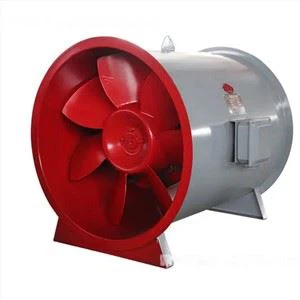
If you’ve ever sourced FRP axial flow fans for industrial or commercial applications, you know that performance testing isn’t just a box to check—it’s the difference between a unit that runs smoothly for 10+ years and one that leads to costly downtime, energy waste, or safety hazards. As a supplier of these corrosion-resistant workhorses, I’ve spent years refining our testing process to ensure every fan leaving our facility meets real-world needs, not just theoretical specs. FRP (Fiber Reinforced Polymer) axial flow fans are unique because their composite construction makes them ideal for harsh environments—think chemical processing plants, wastewater treatment facilities, or underground parking garages with high moisture and corrosive fumes—but that same construction means standard metal fan testing methods often don’t apply.
When a customer reaches out needing an FRP axial flow fan, the first question they ask is usually “Will this fan move enough air to get the job done?” and “Will it hold up when things get tough?” Those two questions are at the heart of performance testing, and skipping steps here is a mistake that comes back to bite both you and the end user. Let’s walk through exactly how we test FRP axial flow fan performance, why each step matters, and how this process translates to a fan that works as hard as your operation does.
First, we start with defining the test parameters that matter most for our customers, not just for certification. Too many suppliers rely on generic ISO standards, but we tailor testing to the specific application the fan is intended for. For example, a ducted flue gas exhaust fan used in an industrial boiler room has different requirements than an underground parking garage ventilation fan. That’s why before we even set up a test, we work with our customers to capture key details: required airflow rate (in CFM or m³/s), static pressure (how much resistance the fan will face from ducts, filters, or system design), operating temperature range, and the type of corrosive or moisture-laden environment the fan will see. To give you an example of one specialized use case, our team often supports customers needing fans for flue gas exhaust applications—you can learn more about our anti-corrosion axial flow fans built for that exact need at Ducted flue gas exhaust fan Fire fan. These details turn a generic performance test into a validation that the fan will work in your exact setup.
The core of performance testing for FRP axial flow fans is adhering to recognized industry standards, but adapting them to FRP’s unique properties. The two main standards we follow are AMCA 210 (Air Movement and Control Association International) for airflow and performance testing, and ISO 5801 for industrial fans, but we add FRP-specific checks that generic metal fan testing skips. Let’s break down the test setup first, because you can’t get accurate data without a properly calibrated setup.


Our test lab is equipped with an AMCA-certified air tunnel, which is non-negotiable. This tunnel is designed to measure airflow, static pressure, and power draw with high precision, and we calibrate it every six months to ensure data accuracy—cutting corners here gives you useless numbers. For FRP fans, we take extra care during test setup: we mount the fan using the same flange and mounting hardware that would be used in the actual system, because FRP’s stiffness means mounting can impact performance. We also test the fan at the exact blade pitch, motor size, and wheel diameter specified for the order, since even a 1-degree change in blade pitch can shift airflow by 10% or more.
Next, we run the key performance curve tests. Every FRP axial flow fan has a performance curve that plots airflow rate against static pressure at a given power input, and this is the most critical data point for customers. To generate this curve, we start with the fan’s free air delivery (FAD) test—this is how much air the fan moves when there’s no duct resistance, just open air. We test FAD by running the fan at its rated RPM and measuring airflow at the outlet of the fan, with no inlet or outlet duct attached. For FRP fans, we also monitor motor temperature during this test, since FRP’s thermal expansion is different from metal; we need to ensure the motor doesn’t overheat during continuous operation at FAD, which would shorten its lifespan.
Once we have FAD, we move to measuring the fan’s performance at varying static pressures. We adjust dampers on the outlet of the air tunnel to create controlled levels of back pressure (mimicking the resistance from ducts, filters, or equipment in the customer’s system) and measure airflow at each pressure point. For example, if a customer’s system has a static pressure of 0.5 inches WG (water gauge) at 10,000 CFM, we run the fan at that exact pressure and airflow, and check that power draw falls within our rated range. This is where many problems show up with untested fans: a fan might hit 15,000 CFM at FAD, but only move 8,000 CFM at 0.5 inches WG, which is a mismatch for your needs. For our FRP axial flow fans, we also confirm that the motor’s power draw doesn’t exceed 110% of its rated capacity at any point on the curve—this prevents overloading, which is a common failure point in industrial fans.
But airflow and pressure aren’t the only performance metrics that matter, especially for FRP fans in harsh environments. We also test for corrosion resistance alongside mechanical and airflow performance, because an FRP fan that can move air but breaks down in 6 months is useless. Here’s where our experience as an FRP fan supplier comes in: we don’t just spray the fan with a salt solution and call it a day (though we do that too). We run a cyclic corrosion test that mimics real-world exposure: we alternate between salt spray (simulating coastal or de-icing salt exposure), high humidity, and elevated temperatures, over a 1,000-hour period. During this test, we monitor fan vibration, airflow, and material integrity. We also test the fan’s FRP wheel and housing for chemical resistance to the specific chemicals the customer will be handling—for example, a fan used in a fertilizer plant is exposed to ammonia, which can degrade some FRP resins, so we test our fans with the exact resin formulation they’ll use against that chemical to ensure no degradation.
Vibration testing is another non-negotiable step that’s often overlooked, but it’s critical for long-term performance. Excessive vibration shortens motor life, damages ductwork, and creates noise issues that can lead to regulatory fines. We test FRP axial flow fan vibration both at rest (to check for wheel imbalance) and during operation at all points on the performance curve. FRP wheels can develop small imbalances during manufacturing, so we perform dynamic balancing at 100% RPM and 120% RPM (to mimic peak operating speed) to ensure vibration levels are below AMCA’s standard limit of 0.1 inches per second. For customers in sensitive applications, like hospitals or data centers, we also measure noise levels during this test, and can adjust the fan’s blade design or add sound dampening to meet strict noise requirements.
One of the most important parts of our testing process is post-test inspection and validation. After every performance test, we disassemble the FRP fan and inspect every component for signs of wear, delamination, or resin breakdown. For example, we check the wheel’s blades for any cracking or separation from the hub, the housing for warping from temperature, and fasteners for corrosion. We also cross-reference all test data with the customer’s order specs to create a full test report, which we provide to every client before shipment. This report includes the performance curve, static pressure at rated airflow, power draw, vibration levels, and corrosion test results—so you have concrete proof that the fan you’re receiving will perform as advertised.
I’ve seen too many customers make the mistake of choosing a cheap FRP axial flow fan supplier that cuts corners on testing. Last year, a wastewater treatment plant client came to us after a 6-month-old fan they’d bought from a different supplier failed. The fan had been rated for 12,000 CFM at 0.4 inches WG, but when we tested it in our lab, it only moved 9,200 CFM at that pressure—plus, the FRP housing had started delaminating from exposure to hydrogen sulfide in the plant’s air. The supplier had only done a basic airflow test, skipping corrosion and full pressure curve testing. That client ended up spending more on emergency replacement costs and downtime than they would have on a properly tested fan from the start.
At the end of the day, testing FRP axial flow fan performance is about matching a fan’s capabilities to your exact operating conditions. Whether you need a fan for a commercial ventilation system, industrial flue gas exhaust, or harsh chemical processing environment, proper testing ensures the fan delivers the airflow, durability, and efficiency you need to keep your operations running smoothly.
If you’re in the market for a reliable FRP axial flow fan and want to discuss performance testing for your specific application, or to learn more about our line of anti-corrosion axial flow fans for specialized uses like ducted flue gas exhaust, feel free to reach out for a consultation. We’re here to help you get a fan that works as hard as you do, without the headaches of underperformance or premature failure.
References
AMCA Standard 210-15: Laboratory Methods of Testing Fans for Certified Aerodynamic Performance Rating
ISO 5801:2017: Industrial fans – Performance testing using standardized airways
ASTM G48-11: Standard Test Methods for Pitting and Crevice Corrosion Resistance of Stainless Steels and Related Alloys by Use of Ferric Chloride Solution