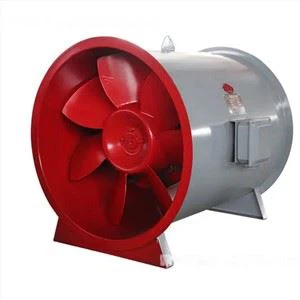
As a supplier of axial flow ventilators, I often encounter inquiries from customers regarding the power consumption of these essential devices. Understanding the power consumption of an axial flow ventilator is crucial for various reasons, including cost - effectiveness, energy efficiency, and overall system design. In this blog, I'll delve into the factors that influence the power consumption of axial flow ventilators, how to calculate it, and its implications for different applications.
Factors Affecting the Power Consumption of Axial Flow Ventilators
1. Airflow Rate
The airflow rate, measured in cubic meters per hour (m³/h) or cubic feet per minute (CFM), is one of the most significant factors affecting power consumption. Generally, the higher the required airflow rate, the more power the ventilator will consume. Axial flow ventilators work by moving air through the blades, and to move a larger volume of air, the motor has to work harder. For example, in a large industrial warehouse where a high volume of air needs to be circulated to maintain proper ventilation, a ventilator with a high airflow rate will be required, which will consume more power compared to a ventilator used in a small room with a lower airflow demand.
2. Static Pressure
Static pressure is the resistance that the ventilator has to overcome to move air through the ductwork, filters, and other components in the ventilation system. When the static pressure is high, the ventilator needs to generate more force to push the air through the system. This increased force requires more power from the motor. In applications such as coal mines, where the ventilation system may have long duct runs and multiple bends, the static pressure can be relatively high. As a result, the axial flow ventilators used in Coal Mine Ventilation Fans | Explosion - Proof Axial Fans need to be designed to handle these high static pressures, which often leads to higher power consumption.
3. Fan Efficiency
The efficiency of the fan itself plays a vital role in power consumption. A more efficient fan can convert a higher percentage of the electrical energy it consumes into useful airflow. Modern axial flow ventilators are designed with advanced blade geometries and motor technologies to improve efficiency. For instance, fans with aerodynamically optimized blades can move more air with less power input compared to older - style fans with less efficient blade designs. When choosing an axial flow ventilator, it is important to consider the fan's efficiency rating, as a more efficient fan can significantly reduce long - term power consumption and operating costs.
4. Motor Characteristics
The motor of the axial flow ventilator is the power source that drives the fan blades. Different motors have different power ratings, efficiencies, and control methods. For example, a high - power motor will consume more electricity than a low - power motor. Additionally, motors with variable speed drives (VSDs) can adjust the speed of the fan according to the actual demand, which can lead to significant energy savings. In applications where the ventilation requirements vary over time, such as in an office building where the occupancy and ventilation needs change throughout the day, using a ventilator with a VSD - equipped motor can help optimize power consumption.


Calculating the Power Consumption of Axial Flow Ventilators
The power consumption of an axial flow ventilator can be estimated using the following formula:
[P=\frac{Q\times\Delta P}{\eta\times 3600\times 1000}]
Where:
- (P) is the power consumption in kilowatts (kW)
- (Q) is the airflow rate in cubic meters per hour (m³/h)
- (\Delta P) is the static pressure in pascals (Pa)
- (\eta) is the overall efficiency of the fan - motor system
Let's take an example. Suppose we have an axial flow ventilator with an airflow rate (Q = 10000\ m³/h), a static pressure (\Delta P=500\ Pa), and an overall efficiency (\eta = 0.7).
[P=\frac{10000\times500}{0.7\times3600\times1000}\approx1.98\ kW]
This calculation gives us an approximate idea of the power consumption of the ventilator under the given conditions. However, it's important to note that in real - world applications, there may be additional losses due to factors such as motor inefficiencies, belt drive losses (if applicable), and system leakage.
Implications of Power Consumption in Different Applications
1. Industrial Applications
In industrial settings, axial flow ventilators are used for a variety of purposes, such as removing fumes, providing fresh air, and maintaining proper temperature and humidity levels. The high - volume and often continuous operation of these ventilators mean that power consumption can have a significant impact on operating costs. For example, in a manufacturing plant, a large number of ventilators may be running 24/7. By choosing energy - efficient ventilators and optimizing the ventilation system design, companies can save a substantial amount of money on electricity bills.
2. Commercial Buildings
In commercial buildings like offices, shopping malls, and hotels, ventilation is essential for the comfort and health of the occupants. The power consumption of axial flow ventilators in these buildings can be managed through proper system design and control. For example, using sensors to detect occupancy and adjust the ventilation rate accordingly can help reduce unnecessary power consumption. Additionally, integrating energy - efficient ventilators into the building's overall energy management system can contribute to achieving sustainability goals.
3. Residential Applications
In residential settings, axial flow ventilators are commonly used in bathrooms, kitchens, and attics. Although the power consumption of individual residential ventilators is relatively low compared to industrial or commercial applications, when multiplied by the large number of households, it can still have a significant cumulative impact on energy consumption. Homeowners can choose energy - efficient ventilators and ensure proper installation and maintenance to minimize power usage.
Strategies to Reduce Power Consumption
1. Optimize System Design
Proper system design can significantly reduce the static pressure in the ventilation system, which in turn reduces power consumption. This includes using straight and short duct runs, minimizing the number of bends and obstructions, and selecting appropriate filters with low pressure drops.
2. Use Energy - Efficient Equipment
As mentioned earlier, choosing axial flow ventilators with high - efficiency motors and blades can lead to substantial energy savings. Look for products with energy - star ratings or other recognized efficiency certifications.
3. Implement Variable Speed Control
Variable speed drives allow the ventilator to adjust its speed according to the actual ventilation demand. This means that the ventilator can run at a lower speed when the demand is low, consuming less power.
4. Regular Maintenance
Regular maintenance of the ventilator, including cleaning the blades, checking the motor, and tightening loose connections, can ensure that the ventilator operates at its optimal efficiency. A well - maintained ventilator will consume less power compared to a neglected one.
Conclusion
The power consumption of an axial flow ventilator is influenced by multiple factors, including airflow rate, static pressure, fan efficiency, and motor characteristics. Understanding these factors and how to calculate power consumption is essential for making informed decisions when selecting and operating axial flow ventilators. Whether in industrial, commercial, or residential applications, reducing power consumption not only saves money but also contributes to a more sustainable future.
If you are in the market for axial flow ventilators and want to discuss your specific requirements, power consumption concerns, or any other related topics, I encourage you to reach out. We can work together to find the most suitable and energy - efficient solutions for your ventilation needs.
References
- ASHRAE Handbook of Fundamentals. American Society of Heating, Refrigerating and Air - Conditioning Engineers.
- Fan Engineering: A Practical Guide. Buffalo Forge Company.
- “Energy Efficiency of Industrial Fans” by the International Energy Agency.