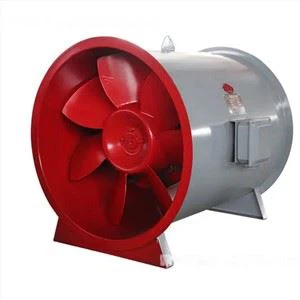
In the realm of indoor ventilation, fans play a pivotal role in ensuring comfort and air quality. Two commonly used types of indoor fans are centrifugal fans and axial fans. As an Indoor Axial Fan supplier, I am often asked about the differences between these two types of fans. In this blog post, I will delve into the characteristics, applications, and advantages of centrifugal and axial indoor fans to help you make an informed decision when choosing the right fan for your indoor space.
Operating Principles
The fundamental difference between centrifugal and axial fans lies in their operating principles. Axial fans work by drawing air in parallel to the axis of the fan blades and pushing it out in the same direction. The blades of an axial fan are designed to create a flow of air that moves straight through the fan. This design is similar to that of a propeller, where the rotation of the blades generates a force that propels the air forward.
On the other hand, centrifugal fans operate by taking in air at the center of the fan (axially) and then expelling it radially outward through the blades. The blades of a centrifugal fan are typically curved and are arranged in a circular pattern around a central hub. As the fan rotates, the air is accelerated by the centrifugal force created by the spinning blades and is then forced out through the outlet of the fan.
Design and Construction
Axial fans are generally simpler in design and construction compared to centrifugal fans. They typically consist of a motor, a set of blades, and a housing. The blades of an axial fan are usually straight or slightly curved and are attached directly to the motor shaft. The housing of an axial fan is designed to direct the flow of air and protect the motor and blades.
Centrifugal fans, on the other hand, are more complex in design and construction. They typically consist of a motor, an impeller (the rotating part with the blades), a housing, and an inlet and outlet. The impeller of a centrifugal fan is usually made up of multiple curved blades that are arranged in a spiral pattern around a central hub. The housing of a centrifugal fan is designed to collect the air that is accelerated by the impeller and direct it towards the outlet.
Airflow and Pressure
One of the key differences between centrifugal and axial fans is their airflow and pressure characteristics. Axial fans are known for their high airflow rates but relatively low pressure capabilities. They are designed to move large volumes of air at low to moderate pressures. This makes them ideal for applications where large amounts of air need to be moved quickly, such as in ventilation systems for large rooms or industrial spaces.
Centrifugal fans, on the other hand, are capable of generating higher pressures but lower airflow rates compared to axial fans. They are designed to move air against resistance, such as in ductwork or systems with filters. This makes them suitable for applications where air needs to be pushed through a long or narrow duct or where there is a high resistance to airflow, such as in HVAC systems or industrial processes.
Noise Levels
Noise levels are an important consideration when choosing an indoor fan. Axial fans tend to be noisier than centrifugal fans, especially at high speeds. This is because the blades of an axial fan create a lot of turbulence as they move through the air, which can result in a loud, whirring noise. However, advancements in fan design and technology have led to the development of quieter axial fans that are suitable for use in indoor environments.
Centrifugal fans, on the other hand, are generally quieter than axial fans. This is because the design of the impeller and housing of a centrifugal fan helps to reduce turbulence and noise. Additionally, centrifugal fans can be designed with features such as sound insulation and vibration dampening to further reduce noise levels.
Energy Efficiency
Energy efficiency is another important factor to consider when choosing an indoor fan. Axial fans are generally more energy-efficient than centrifugal fans, especially when operating at low to moderate speeds. This is because axial fans have a simpler design and require less power to operate compared to centrifugal fans. However, the energy efficiency of an axial fan can be affected by factors such as the size and design of the blades, the motor efficiency, and the operating conditions.
Centrifugal fans, on the other hand, can be less energy-efficient than axial fans, especially when operating at high pressures. This is because centrifugal fans require more power to generate the higher pressures needed to move air through a system. However, the energy efficiency of a centrifugal fan can be improved by using a high-efficiency motor, optimizing the design of the impeller and housing, and operating the fan at the appropriate speed.
Applications
The differences in airflow, pressure, noise levels, and energy efficiency between centrifugal and axial fans make them suitable for different applications. Axial fans are commonly used in applications where large volumes of air need to be moved quickly and at low to moderate pressures, such as in:
- Residential ventilation: Axial fans are often used in bathrooms, kitchens, and attics to remove stale air and moisture from the home.
- Industrial ventilation: Axial fans are used in factories, warehouses, and other industrial spaces to provide ventilation and cooling.
- Agricultural ventilation: Axial fans are used in greenhouses, barns, and other agricultural facilities to provide ventilation and temperature control.
Centrifugal fans, on the other hand, are commonly used in applications where air needs to be pushed through a long or narrow duct or where there is a high resistance to airflow, such as in:
- HVAC systems: Centrifugal fans are used in heating, ventilation, and air conditioning (HVAC) systems to circulate air through the ductwork and distribute it to different parts of a building.
- Industrial processes: Centrifugal fans are used in industrial processes such as drying, painting, and dust collection to move air through the system and remove contaminants.
- Commercial ventilation: Centrifugal fans are used in commercial buildings such as offices, shopping malls, and hotels to provide ventilation and air conditioning.
Why Choose Our Indoor Axial Fans
As an Indoor Axial Fan supplier, we offer a wide range of high-quality axial fans that are designed to meet the needs of different applications. Our axial fans are known for their high airflow rates, energy efficiency, and quiet operation. Here are some of the reasons why you should choose our indoor axial fans:


- Wide range of sizes and models: We offer a wide range of axial fans in different sizes and models to suit your specific needs. Whether you need a small fan for a residential application or a large fan for an industrial application, we have the right fan for you.
- High-quality construction: Our axial fans are built to last. They are made from high-quality materials and are designed to withstand the rigors of continuous use.
- Energy-efficient operation: Our axial fans are designed to be energy-efficient, which can help you save on your energy costs. We use high-efficiency motors and advanced blade designs to ensure that our fans operate at the lowest possible power consumption.
- Quiet operation: Our axial fans are designed to operate quietly, which makes them suitable for use in indoor environments. We use advanced noise reduction technologies to minimize the noise generated by the fan.
- Customizable options: We offer customizable options for our axial fans, such as different blade materials, motor speeds, and mounting options. This allows you to customize the fan to meet your specific requirements.
Conclusion
In conclusion, the choice between a centrifugal and an axial indoor fan depends on the specific requirements of your application. Axial fans are ideal for applications where large volumes of air need to be moved quickly and at low to moderate pressures, while centrifugal fans are suitable for applications where air needs to be pushed through a long or narrow duct or where there is a high resistance to airflow. As an Indoor Axial Fan supplier, we offer a wide range of high-quality axial fans that are designed to meet the needs of different applications. If you are looking for a reliable and efficient indoor axial fan, please contact us to discuss your requirements. We would be happy to help you choose the right fan for your indoor space.
References
- ASHRAE Handbook - Fundamentals. American Society of Heating, Refrigerating and Air-Conditioning Engineers, Inc.
- Fan Engineering: A Practical Guide. Buffalo Forge Company.
- Industrial Ventilation: A Manual of Recommended Practice. American Conference of Governmental Industrial Hygienists.
If you are interested in our Wall Axial Fan or other indoor axial fans, please feel free to contact us for more information and to discuss your procurement needs. We look forward to working with you to provide the best ventilation solutions for your indoor spaces.