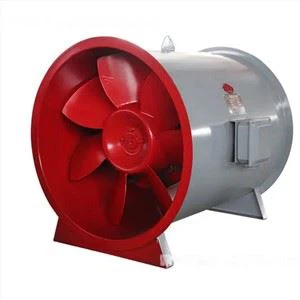
As a supplier of anti - corrosion fans, I've witnessed firsthand the critical role these fans play in various industrial settings. One of the most important factors that can significantly impact the performance and longevity of an anti - corrosion fan is its temperature resistance, which varies greatly depending on the materials used in its construction. In this blog, I'll delve into how the temperature resistance of anti - corrosion fans changes with different materials.
Understanding Temperature Resistance in Anti - Corrosion Fans
Temperature resistance refers to a fan's ability to maintain its structural integrity, mechanical properties, and performance under high - temperature conditions. In corrosive environments, such as chemical plants, waste treatment facilities, and pickling workshops, fans are often exposed to both corrosive substances and high temperatures. A fan with poor temperature resistance may experience deformation, material degradation, and reduced efficiency, leading to premature failure and costly replacements.


Common Materials for Anti - Corrosion Fans and Their Temperature Resistance
Fiberglass Reinforced Plastic (FRP)
FRP is a popular choice for anti - corrosion fans due to its excellent corrosion resistance and relatively good temperature resistance. It is made by embedding glass fibers in a resin matrix. The resin can be epoxy, polyester, or vinyl ester, each with different temperature ratings.
- Epoxy Resin - Based FRP: Epoxy resin offers good adhesion and mechanical properties. Epoxy - based FRP fans can typically withstand temperatures up to around 80 - 100°C (176 - 212°F). At higher temperatures, the epoxy resin may start to soften, leading to a decrease in the fan's structural strength and potentially causing deformation.
- Polyester Resin - Based FRP: Polyester resin is more cost - effective but has a lower temperature resistance compared to epoxy. Polyester - based FRP fans usually have a maximum operating temperature of about 60 - 80°C (140 - 176°F). Beyond this temperature range, the polyester resin may degrade, reducing the fan's anti - corrosion and mechanical performance.
- Vinyl Ester Resin - Based FRP: Vinyl ester resin combines the best of both worlds, offering better corrosion resistance and higher temperature resistance than polyester resin. Vinyl ester - based FRP fans can handle temperatures up to 120 - 130°C (248 - 266°F) in some cases. This makes them suitable for applications where the temperature is moderately high, such as in some chemical fume exhaust systems.
Stainless Steel
Stainless steel is another widely used material for anti - corrosion fans. Different grades of stainless steel have different temperature resistance capabilities.
- 304 Stainless Steel: This is a common grade of stainless steel. It has good corrosion resistance in many environments and can withstand temperatures up to around 870°C (1600°F) in intermittent service and 760°C (1400°F) in continuous service. However, in corrosive environments, the high - temperature performance may be affected by factors such as the presence of chlorides.
- 316 Stainless Steel: 316 stainless steel contains molybdenum, which enhances its corrosion resistance, especially in chloride - containing environments. It has similar high - temperature performance to 304 stainless steel but may have better resistance to corrosion - induced degradation at high temperatures. For anti - corrosion fans, 316 stainless steel is often used in applications where both corrosion and relatively high temperatures are present, such as in coastal industrial areas or some food processing plants.
Polypropylene
Polypropylene is a thermoplastic polymer known for its excellent chemical resistance and low cost. However, its temperature resistance is relatively limited.
- Polypropylene fans can typically operate at temperatures up to around 80 - 100°C (176 - 212°F). At higher temperatures, polypropylene may start to deform, and its mechanical properties will deteriorate rapidly. Therefore, polypropylene is more suitable for applications where the temperature is relatively low and the corrosive environment is not too harsh, such as in some small - scale chemical laboratories or low - temperature pickling processes.
Impact of Temperature on Fan Performance
Regardless of the material, high temperatures can have several negative impacts on anti - corrosion fans:
- Mechanical Degradation: As the temperature rises, the material may expand, leading to changes in the fan's dimensions. This can cause misalignment of the fan blades, increasing vibration and noise. Over time, the mechanical stress on the fan components may lead to fatigue and eventual failure.
- Reduced Corrosion Resistance: High temperatures can accelerate the corrosion process. For example, in a corrosive gas environment, the chemical reactions between the corrosive substances and the fan material may occur more rapidly at higher temperatures. This can lead to the formation of pits, cracks, and other forms of corrosion damage, reducing the fan's service life.
- Efficiency Loss: The increase in temperature can also affect the aerodynamic performance of the fan. The density of the air decreases with increasing temperature, which may lead to a decrease in the fan's volumetric flow rate and pressure - generating capacity. As a result, the fan may not be able to provide the required ventilation or exhaust capacity.
Selecting the Right Material Based on Temperature Requirements
When selecting an anti - corrosion fan, it is crucial to consider the temperature conditions of the application environment.
- Low - Temperature Applications: If the temperature in the environment is below 80 - 100°C (176 - 212°F), polypropylene or polyester - based FRP fans can be cost - effective options. They offer good corrosion resistance and can meet the basic ventilation needs in many low - temperature corrosive environments.
- Moderate - Temperature Applications: For applications where the temperature ranges from 80 - 130°C (176 - 266°F), vinyl ester - based FRP or 316 stainless steel fans are more appropriate. These materials can withstand the moderate temperatures while maintaining their anti - corrosion properties.
- High - Temperature Applications: When the temperature exceeds 130°C (266°F), 304 or 316 stainless steel fans are usually the best choice. They can handle the high - temperature conditions and still provide reliable performance in corrosive environments.
Our Product Offerings
As a leading supplier of anti - corrosion fans, we offer a wide range of products made from different materials to meet various temperature and corrosion requirements. Our Ducted flue gas exhaust fan Fire fan is designed for applications where high - temperature flue gas needs to be exhausted. It is made from high - quality stainless steel to ensure excellent temperature resistance and corrosion resistance.
Our Enhance Your Industrial Environment with Smoke Exhaust Fans are suitable for industrial settings where both smoke and corrosive substances are present. These fans are available in different materials, including FRP and stainless steel, to provide the right solution for different temperature and corrosion scenarios.
For applications where corrosion is the main concern and the temperature is relatively low, our Anti - Corrosion Cooling Fan made from polypropylene or FRP can be an ideal choice.
Contact Us for Procurement and Consultation
If you are in need of an anti - corrosion fan and are unsure which material is best for your specific application, our team of experts is here to help. We can provide detailed technical advice and recommend the most suitable product based on your temperature, corrosion, and ventilation requirements. Whether you are in the chemical industry, waste treatment, or any other sector that requires anti - corrosion ventilation solutions, we are committed to providing you with high - quality products and excellent service. Please feel free to contact us for procurement and in - depth discussions about your project needs.
References
- ASM Handbook, Volume 13A: Corrosion: Fundamentals, Testing, and Protection. ASM International.
- Perry's Chemical Engineers' Handbook. McGraw - Hill Education.
- "Temperature Effects on the Mechanical and Corrosion Properties of Engineering Materials" by various authors in relevant engineering journals.