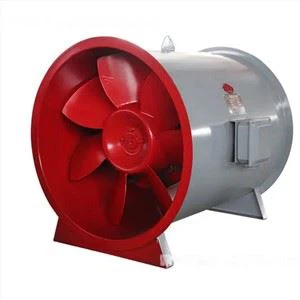
When it comes to ventilation systems, fans play a crucial role in ensuring proper air circulation and maintaining a comfortable and healthy environment. Among the various types of fans available in the market, roof axial flow fans stand out with their unique characteristics and advantages. As a supplier of roof axial flow fans, I am well - versed in the differences between these fans and other types, and I'm excited to share this knowledge with you.
Basic Working Principles
Let's start by understanding the basic working principles of different fans. Axial flow fans, including roof axial flow fans, operate by using blades to move air in a direction parallel to the axis of the fan shaft. The blades are designed to draw air in at one end and expel it out the other end in a straight line. This is similar to the way an airplane propeller moves air.
In contrast, centrifugal fans work on a different principle. They use a rotating impeller to accelerate the air radially and then change its direction as it exits the fan housing. This creates a high - pressure airflow, which is useful in applications where air needs to be forced through ducts or against resistance. For example, in HVAC systems with long duct runs, centrifugal fans are often preferred because they can generate the necessary pressure to move air effectively.
Design and Structure
The design and structure of roof axial flow fans are tailored to their specific application on rooftops. These fans typically have a relatively simple and compact design. They are usually mounted directly on the roof, with a housing that protects the motor and blades from the elements. The blades are often made of lightweight and durable materials such as aluminum or fiberglass, which can withstand harsh weather conditions.
On the other hand, other types of fans may have more complex designs. For instance, ceiling fans are designed to be suspended from the ceiling and have a more aesthetically - pleasing appearance. They usually have a slower - moving blade design to create a gentle breeze for personal comfort. Wall - mounted fans are designed to be attached to a wall, and their size and shape are optimized for this type of installation.
Airflow and Performance
Roof axial flow fans are known for their high - volume, low - pressure airflow. They are capable of moving large amounts of air quickly, which makes them ideal for applications such as ventilating large industrial spaces, warehouses, and agricultural buildings. The large - diameter blades and high - speed rotation allow these fans to draw in and expel air efficiently, reducing heat, humidity, and odors.
Centrifugal fans, as mentioned earlier, are better at generating high - pressure airflow. This makes them suitable for applications where air needs to be pushed through ducts with significant resistance, such as in commercial HVAC systems. However, their airflow volume may be lower compared to axial flow fans of the same size.
Ceiling fans, on the other hand, are designed to provide a more localized and gentle airflow. They are not intended for large - scale ventilation but rather for creating a comfortable micro - environment in a room.
Energy Efficiency
Energy efficiency is an important consideration in any ventilation system. Roof axial flow fans are generally more energy - efficient when it comes to moving large volumes of air. Their simple design and direct airflow path result in less energy loss compared to some other types of fans. Additionally, many modern roof axial flow fans are equipped with energy - efficient motors that can further reduce power consumption.
Centrifugal fans may consume more energy, especially when operating at high pressures. However, in applications where high - pressure airflow is required, the energy efficiency of a well - designed centrifugal fan can still be acceptable. Ceiling fans typically consume very little energy, but their limited airflow capacity means they are not suitable for large - scale ventilation needs.


Noise Level
Noise can be a significant factor, especially in environments where quiet operation is desired. Roof axial flow fans are designed to operate with relatively low noise levels. The aerodynamic design of the blades and the use of high - quality motors help to minimize noise generation. However, in large - scale installations with multiple fans, the cumulative noise can still be a concern.
Centrifugal fans can produce more noise, especially when operating at high speeds or under high - pressure conditions. The complex airflow patterns and the interaction between the impeller and the housing can contribute to increased noise levels. Ceiling fans are generally very quiet, as they are designed for use in residential and office environments.
Applications
As a roof axial flow fan supplier, I know that these fans are widely used in a variety of applications. In industrial settings, they are used to ventilate factories, workshops, and warehouses to remove heat, fumes, and dust. They are also commonly used in agricultural buildings such as barns and poultry houses to maintain proper air quality and temperature.
Centrifugal fans are often used in HVAC systems, both in commercial and residential buildings. They are also used in industrial processes where air needs to be forced through filters or other equipment. Ceiling fans are mainly used in homes, offices, and restaurants to provide a comfortable airflow for personal comfort.
Cost
The cost of different types of fans can vary significantly. Roof axial flow fans are generally more cost - effective, especially for large - scale ventilation projects. Their simple design and relatively low manufacturing costs make them an attractive option for many customers.
Centrifugal fans can be more expensive, especially high - performance models with advanced features. The cost of installation and maintenance can also be higher due to their more complex design. Ceiling fans are usually the most affordable option, but their limited functionality means they are not suitable for all applications.
Our Product Offerings
As a supplier of roof axial flow fans, we offer a wide range of products to meet different customer needs. Our Industrial Axial Flow Roof Top Air Extractor Fan Mushroom Exhaust Fan is designed for heavy - duty industrial applications. It has a robust construction and high - efficiency blades to ensure reliable operation.
We also have Booster Fan Duct Booster Fan for applications where additional airflow pressure is required. These fans can be used in conjunction with existing ventilation systems to improve performance.
In addition, our Exhaust Fan Roof Air Vent Fan Manufacturer products are known for their quality and durability. They are designed to provide effective ventilation for a variety of rooftop applications.
Conclusion
In conclusion, roof axial flow fans differ from other types of fans in many aspects, including working principles, design, airflow, energy efficiency, noise level, applications, and cost. Understanding these differences is crucial for choosing the right fan for your specific needs. Whether you are looking to ventilate a large industrial space or a small residential room, there is a fan that is best suited for the job.
If you are interested in our roof axial flow fans or have any questions about ventilation systems, please feel free to contact us. We are committed to providing high - quality products and excellent customer service. Our team of experts can help you select the right fan for your application and provide you with all the necessary support during the installation and operation process.
References
- ASHRAE Handbook of Fundamentals.
- Fan Engineering: The Application, Analysis, and Design of Fans.
- Industrial Ventilation: A Manual of Recommended Practice.