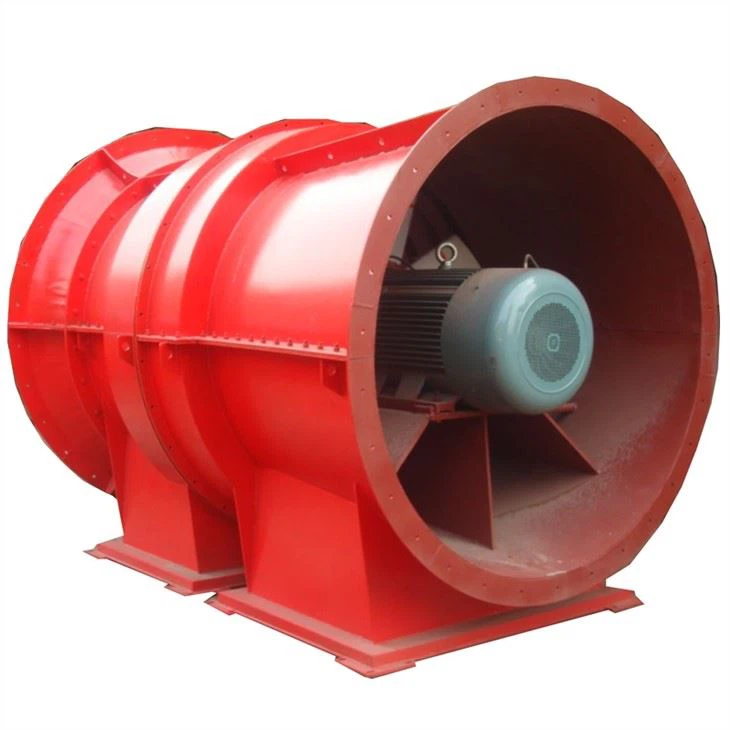
Hey there! As a supplier of Withdraw Axial Fans, I often get asked about how to measure the airflow of these fans. It's a crucial aspect, especially when it comes to ensuring that the fans are performing optimally in various applications. So, let's dive right into it and explore the different ways to measure the airflow of a withdraw axial fan.
Why Measuring Airflow Matters
First off, why do we even need to measure the airflow? Well, accurate airflow measurement helps in determining if the fan is delivering the required amount of air for a specific task. Whether it's for ventilation in a mine, cooling in an industrial setting, or air circulation in a building, knowing the airflow rate allows us to assess the fan's efficiency and performance. If the airflow is too low, it might not be able to meet the demand, leading to issues like poor ventilation or inadequate cooling. On the other hand, if it's too high, it could result in unnecessary energy consumption and increased wear and tear on the fan.
Methods of Measuring Airflow
Anemometer Method
One of the most common ways to measure airflow is by using an anemometer. An anemometer is a device that measures the speed of the air. To use it with a withdraw axial fan, you need to place the anemometer at the outlet of the fan. Make sure to take multiple readings at different points across the outlet to get an average speed.
Here's a step - by - step guide on how to do it:
- Prepare the Anemometer: Ensure that the anemometer is calibrated and set to the appropriate units (usually meters per second or feet per minute).
- Position the Anemometer: Place the anemometer at the center of the fan outlet. Take a reading and record it.
- Take Multiple Readings: Move the anemometer to different positions across the outlet, such as the corners and the edges. Take readings at each position.
- Calculate the Average Speed: Add up all the readings and divide by the number of readings to get the average airspeed.
Once you have the average airspeed, you can calculate the airflow by multiplying the average airspeed by the cross - sectional area of the fan outlet. The formula is:
[Q = V\times A]
where (Q) is the airflow (in cubic meters per second or cubic feet per minute), (V) is the average airspeed, and (A) is the cross - sectional area of the fan outlet.
Pitot Tube Method
Another method is using a pitot tube. A pitot tube measures the total pressure and the static pressure of the air. The difference between the total pressure and the static pressure is called the dynamic pressure, which can be used to calculate the airspeed.
Here's how you use a pitot tube:
- Insert the Pitot Tube: Insert the pitot tube into the airflow at the fan outlet. Make sure it is aligned with the direction of the airflow.
- Measure the Pressures: Use a pressure gauge to measure the total pressure and the static pressure.
- Calculate the Dynamic Pressure: Subtract the static pressure from the total pressure to get the dynamic pressure.
- Determine the Airspeed: Use the following formula to calculate the airspeed:
[V=\sqrt{\frac{2\times\Delta P}{\rho}}]
where (V) is the airspeed, (\Delta P) is the dynamic pressure, and (\rho) is the density of the air.
After getting the airspeed, you can calculate the airflow in the same way as with the anemometer method, by multiplying the airspeed by the cross - sectional area of the fan outlet.
Flow Hood Method
A flow hood is a large, cone - shaped device that can be placed over the fan outlet. It measures the total airflow directly.
To use a flow hood:
- Position the Flow Hood: Place the flow hood over the fan outlet, making sure it forms a tight seal.
- Take the Reading: The flow hood will display the airflow rate directly on its screen.
This method is relatively easy to use, but flow hoods can be expensive and may not be suitable for all applications.

Factors Affecting Airflow Measurement
There are several factors that can affect the accuracy of airflow measurement. One of the main factors is the presence of turbulence. Turbulence can cause the airspeed to vary significantly across the outlet, making it difficult to get an accurate average. To minimize the effect of turbulence, you can use a straightening vane or a diffuser at the outlet of the fan.
Another factor is the temperature and humidity of the air. The density of the air changes with temperature and humidity, which can affect the calculations. Make sure to take these factors into account when calculating the airflow.
Applications of Withdraw Axial Fans and Airflow Measurement
Withdraw axial fans are used in a wide range of applications. For example, in mining, they are used for ventilation. Counter Rotating Mining Fan and Exhaust Fan for Mining are two types of fans commonly used in mines. Measuring the airflow of these fans is crucial to ensure proper ventilation and the safety of the miners.
In industrial settings, withdraw axial fans are used for cooling machinery and removing hot air. Explosion - Proof Axial Flow Fan for Mine Ventilation - 10,000 - 300,000 m³/h is an example of a fan used in potentially explosive environments. Accurate airflow measurement helps in maintaining the right temperature and preventing overheating.
Conclusion
Measuring the airflow of a withdraw axial fan is an important part of ensuring its proper performance. There are several methods available, such as using an anemometer, a pitot tube, or a flow hood. Each method has its own advantages and disadvantages, and the choice of method depends on the specific application and the level of accuracy required.
If you're in the market for a high - quality withdraw axial fan or need more information on airflow measurement, don't hesitate to reach out. We're here to help you make the right choice for your needs. Whether it's for mining, industrial, or other applications, we've got the expertise and the products to meet your requirements. Contact us today to start a discussion about your fan needs and how we can assist you in getting the best performance out of your equipment.
References
- ASHRAE Handbook - Fundamentals. American Society of Heating, Refrigerating and Air - Conditioning Engineers.
- "Industrial Ventilation: A Manual of Recommended Practice". American Conference of Governmental Industrial Hygienists.